I’ve wanted to develop a recipe with cuttlefish for a long time now. At work, their peculiar and often very inky forms make an occasional appearance on the slab, but due to the sporadic nature of their availability, until now I haven’t quite managed to steal the right moment. And I thought that this summer would be very much the same, and instead I’ve been largely (and very happily) feasting on its close relations, the octopus and the squid. So when I opened a box one sunny morning a few weeks ago and was greeted by pile of particularly fine specimens, I just knew I had to take some home and fire up the hobs.

Cuttlefish is definitely something that we should be eating more of in this country. But unlike squid or octopus that are well and truly pinned onto the food map, cuttlefish gets all the bad press. That is, no press at all. Admittedly as a fishmonger they can be a bit of a nightmare due to their tendency to be messy and time consuming to prepare. But often it doesn’t even reach that point, with customers going down the safe old salmon, cod and tuna route. With the prices of these prime fish soaring, the cuttlefish still carries an unfashionable price tag, has bags of flavour and is a doddle to cook. All it needs is a decent national PR spin…
This dish represents exactly the type of food that I love to eat as we slide into Autumn with a chilly wind and grey cloud of rain. Slow, easy cooking that is all about the development of flavour over a little patient simmering. Food that can be sliced and eaten with a spoon. Now we’re in September, the shellfish will start to get slightly stronger, and soon we’ll see Shetland mussels back in their prime. Samphire is slowly heading the other way, and I’m finding any excuse to introduce a handful into my meals. Before long that vibrant green will be replaced by the burnished oranges and reds of squashes, apples and corn. I can’t wait.
Serves 2 for a main, or 4 for a lunch or starter
Ingredients:
2-3 small cuttlefish, cleaned, with the tentacles and ink sacs reserved
1 onion, finely sliced
2 cloves of garlic, grated
1 tsp fennel seeds
1 tsp dried chilli flakes
1 tsp dried oregano
1 glass of white wine
500ml chicken stock
2 sachets of cuttlefish ink
¾ of a mug of firm lentils, such as Puy
1 lemon, juice and zest
1 small bunch of parsley, finely chopped
To finish:
12-15 clams
A handful of samphire
The tentacles from the cuttlefish, cut into 3 or 4 pieces
Slice the cleaned and skinned body and wings of the cuttlefish into chunky centimetre-thick strips. Pour a generous glug of olive oil into a large saucepan and bring up to a medium-high temperature. Fry the cuttlefish for 3-4 minutes, turning occasionally, until they start to turn golden. Season well. Turn the heat down slightly and add the onion, garlic, fennel seeds, dried chilli and oregano. Continue to fry everything together for a couple of minutes, stirring occasionally, until the onions soften slightly. Turn the head back up and pour in the wine. Allow the liquid to bubble away and reduce by half. Stir in the ink from the sachets, and carefully squeeze in the ink collected from the cuttlefish sacs (use an extra two sachets if you can’t collect them). Stir well, then top up with the chicken stock. Bring back to the boil, then turn down to a very gently simmer. Cover the saucepan with a lid and cook for 30 minutes.

After 30 minutes, pour the lentils into the saucepan and stir everything well. Continue to simmer for a further 30 minutes.
Bring a frying pan to a high heat and pour in a good glug of olive oil. When the pan is very hot, add the cuttlefish tentacles and a good pinch of seasoning. Fry for 2-3 minutes, turning once, until golden and slightly crispy. Remove from the pan onto a plate lined with kitchen paper to drain. Keep warm.
Bring a saucepan to a high heat. Add the clams and a small splash of water. Seal the pan tightly with a lid, and cook for 3-4 minutes, until the clams all open. Turn the heat down and stir in the samphire. Cook for a further minute, then remove from the heat.
Finish the lentils by stirring in the parsley and squeezing in the lemon juice. Taste and add more seasoning if needed.
To serve, spoon the lentils and cuttlefish into shallow bowls and top with the samphire, clams and crispy tentacles. Finish with a scattering of the lemon zest and a good drizzle of extra virgin olive oil.
I spent the weekend just passed on a whistle-stop visit to Brighton to celebrate my mum’s 68th birthday. And as is now tradition, I arrived clutching a bag of provisions to make lunch on the Sunday. Wherever they have lived, the kitchen has always been the central point of the house, and it was a total pleasure preparing food and catching up as they sat around the table with a glass of wine. As usual, I wanted to keep things simple and quick, just a few seasonal and tested ingredients together on a plate.

In the morning mum and I had driven to their lovely allotment on the hills overlooking the city, shrouded in the morning mist and spitting rain. There we collected beautiful courgette flowers, herbs, salad leaves and bulbs of garlic. They are always so humble about it, but I know how hard they work planning, digging, planting and watering, and I’m always blown away by the produce that flourishes in the neat beds and winds around geometric canes. It was exciting to collect food knowing that it would be on the plate within a few small hours.
First course out of my bag was a paper-wrapped package bulging with squid. Dad gasped. The man loves his squid, and some of my fondest childhood memories involve visits to fishmongers with him. Without fail, dad would always be drawn to squid, and we would rush home to fry them in a thin, crispy batter. On this occasion they were seared quick and fast, until charring at the edges, before being drenched in lemon juice.
I can’t get enough of samphire at the moment, so a few handfuls were also thrown into the mix. Combined with the incredibly tender young courgettes and a tangy dressing, they sat perfectly alongside the squid. This whole dish took about 15 minutes to casually put together, perfect for maximising time sat down eating together.
Serves 4
Ingredients:
4 medium squid, cleaned
4 small handfuls of samphire
4-6 baby courgettes, with flowers if possible
2 sprigs of marjoram
1 lemon
1 clove of garlic
1 good pinch of dried chilli flakes
Extra virgin olive oil
Fill a saucepan with water, and bring to the boil. Fill a large bowl with cold water and add a good handful of ice cubes. When the water in the pan is hot, tip in the samphire and blanche for 20 seconds. Drain and transfer straight into the iced water to cool quickly. When cold, drain and shake dry, then add to a large bowl.
Tear up the courgette flowers (discarding the stamen). Slice the courgettes into long, thin batons. Add both to the samphire, along with the chilli flakes, the lemon zest and half of the juice, the marjoram leaves and the finely grated garlic. Pour in 2-3 tbsp of olive oil and a good pinch of seasoning and toss to combine.
Using a sharp knife, open up the cleaned squid bodies to create a flat sheet. Carefully score one side in a crisscross, and repeat with the wings. Slice the tentacles into a few pieces.
Bring a large, heavy frying pan to a high heat and add 2 tbsp of olive oil. When smoking hot, add the squid and a pinch of seasoning. Cook the squid, in batches if necessary, for one minute on each side, or until golden brown and caramelised.
To serve, layer the squid and the samphire and courgette salad onto each plate. Finish with an extra squeeze of lemon juice and a crack of black pepper.
This is a true late spring dish that these warm, sunny evenings have been screaming out for. After many months of waiting, I was excited to see the first of the newly picked samphire arrive at the shop, but I certainly wasn’t the only one. This marsh grass has a crazy effect on people, and soon I was scraping the bottom of the box, desperate to salvage just one last handful. Samphire, samphierre, sampher, salicorne, seaweed, that green stuff, the names are endless, and I hear new ones every summer. But call it what you will, it does magical things when cooked with fish. And lamb for that matter.

Following the seasons makes dreaming up new ideas a total doddle, and this recipe is a prime example. In the same few weeks that the samphire emerged, we also started receiving the first of the wild black bream that visit Cornwall and the south coast every spring. These deep, darkly-scaled fish are true beauties, with flesh firm with freshness flashing blue and silver in the light. Closely related to seabass, they cook in a similar way, and are best filleted and pan-fried until crisp, or roasted whole in a hot oven. Even if you do decide to go with fillets, make sure that you take the bones as well. It’s always nice to use the whole of an ingredient, and the carcass of the bream will provide a lovely stock.
Unlike the samphire and the black bream, the mussel season only has a few weeks remaining. As the weather and seas warm for the summer, their quality really does decline, and it’s best to hold on until September before you plan your next mariniere. But if you’re quick, you will still be able to sneak a bowl or two before this exodus. Although clams tend to get all of the glory with their pretty shells and classy spaghetti alle vongole, I adore the rich flavour of the humble, cheap mussel. In this dish they are cooked and then blitzed into a silky, buttery sauce, that really brings the fish and greens and potatoes together as one. But made in a larger quantity, the same method would make a fantastic soup. Just add a wedge of bread.
Serves 2
Ingredients:
1 black bream, approx. 1kg in weight. Scaled, filleted and pin-boned
1 large knob of butter
For the fish stock:
The cleaned bones from the black bream
1 carrot, roughly chopped
2 shallots, halved with the skins left on
The trimmings from the fennel bulb
1 clove of garlic, crushed
A handful of fresh parsley
1 tsp fennel seeds
1 bay leaf
For the mussel sauce:
500g mussels, cleaned and de-bearded
1 fennel bulb, finely chopped
1 clove of garlic, grated
½ tsp chilli flakes
1 large glass of white wine
A squeeze of lemon juice
The reduced fish stock
1 large knob of butter
For the Jersey Royals:
6-8 small Jersey Royal potatoes, washed
To finish:
6 stems of purple sprouting broccoli
A generous handful of samphire
To begin with make the stock. Place all of the ingredients and a good pinch of seasoning into a large saucepan and cover with water. Bring to the boil, then simmer for 20 minutes. Strain the liquid through a sieve into a smaller saucepan, then set on a high heat and return to the boil. Reduce the liquid by three quarters.
Put the washed Jersey Royals into a small saucepan and cover with well-salted, cold water. Bring to the boil, then simmer until tender, about 20 minutes. Drain and rinse well with cold water to halt the cooking process. Using a butter knife, scrape off the skins and discard. Set the potatoes aside to reheat later.
Fill a saucepan with water and stir in a good pinch of salt. Bring to the boil, then blanch the trimmed broccoli stems for 2-3 minutes, or until just tender. While the broccoli is cooking, fill a large bowl up with very cold water. Transfer the al-dente broccoli to the cold water to shock. Repeat this process with the samphire, boiling for 30 seconds to soften slightly.
Bring a large saucepan to a medium-low heat. Add a good glug of olive oil and add the fennel, garlic and chilli flakes, and sweat until soft. Turn the heat of the pan up and tip in the mussels and the wine. Cover with a lid and allow the mussels to steamfor 3-4 minutes, or until all of the mussels have opened. Allow to cool slightly, the remove the meat from the shells with a spoon, discarding the shells. Reserve 6-8 mussels aside to decorate the dish when plating. Transfer the remaining mussels and vegetables to a food processor and blend well. While the motor is still running, pour in enough of the stock reduction to loosen into a smooth sauce. Squeeze in the lemon juice and season to taste. Strain the sauce through a sieve into a small saucepan.

Set a non-stick frying pan to a high heat. Pour in a generous amount of olive oil and season the bream fillets all over with salt and pepper. When the pan is hot, place them skin-side down into the pan and fry for 3 minutes. As the fish is cooking, carefully use a spoon to baste the flesh side of the fish with the hot oil. Add a knob of butter to the pan fry for a further minute, continuing the basting process. Remove the fish from the pan to a warm side plate.
Turn the heat of the pan down slightly and add the potatoes, samphire, broccoli and reserved mussels. Cook for 1-2 minutes to warm through, adding seasoning to taste.
Reheat the mussel sauce, then finish by beating in the knob of butter until fully emulsified.
Lay half of the sprouting broccoli onto each plate and top with a piece of fish. Arrange the potatoes, samphire and mussels around the sides. Finish with a generous amount of the mussel sauce.
Now that we’re into June the produce is really coming along. The first broad beans are threatening, and I know it won’t be long until my favourite peas start to make an appearance. Expect many a pea love in anytime soon. We’re still clinging on to asparagus, and lovely Jersey Royal potatoes and samphire are back on the menu. Sadly though this time of year spells the end of the wild garlic season, but I think I’ve rinsed it quite enough; using it wherever possible to flavour stuffings, oils and salads. I’ve just about managed to sneak it into this recipe, but from now on I’ll have to slowly build up my anticipation for next spring.
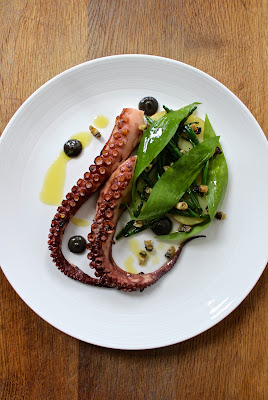
One ingredient that I haven’t rinsed is octopus. I probably on average cook one octopus a year, but that definitely needs to change. A more moreish, delicious thing I struggle to imagine. At work we sell a fair few of these lovable beasts every week, but mostly to Spanish or Italian customers who don’t blink at leaving the shop lugging a 3kg cephalopod behind them. The majority of others squirm, or pull a funny face at a glance! I guess they are slightly intimidating if you’ve never had a go at cooking one before, but you quickly learn how easy and satisfying the results are. Nevertheless, and slightly devastatingly, Katie really isn’t a fan, so I always have to try and steal an evening or afternoon when she is elsewhere before I can quench my octopus cravings. A sunny day last week provided the ideal opportunity…
Freezing food rarely improves it, but with octopus (octopi? octopuses? octopus?...) the process performs miracles. Traditionally to tenderise the firm, elastic flesh you would have to bash the living daylights out of it with a mallet, or flail it against the nearest rock. But after a quick stay in the freezer, all of this is done for you. All that is then required is a gentle simmer for just under an hour and it’ll be wonderfully soft. At this point it is ready to eat, and can be tossed through a salad, drenched in marinades or merely sliced and nibbled on at will, but I think that a quick exposure to a fierce heat really gets the best out of it. The deep, savoury, smoky flavour and crispy/soft combination is so addictive. I polished off the lot.
This is less of a hot dish, more along the lines of a warm salad; and as I discovered with the leftovers, is equally delicious cold. The longer that the lemon marinade gets to slosh around and permeate into the potatoes, samphire and octopus the better. And it’s a fact that a bit of mayonnaise will always make things better.
Serves 4
Ingredients:
For the octopus:
1 Mediterranean octopus, the double sucker variety, about 1 kg, cleaned
2 shallots, sliced
1 fennel bulb, sliced
2 garlic cloves
1 bay leaf
½ a lemon
1 large glass of white wine
For the squid ink mayonnaise:
2 sachets of squid or cuttlefish ink
2 egg yolks
1 clove of garlic, grated
1 tsp Dijon mustard
250ml olive oil
1 lemon, zest and juice
1 tbsp white wine vinegar
For the jersey royal potatoes:
4-6 medium-sized jersey royal potatoes, washed
2 lemons, juice only
1 large clove of smoked garlic, thinly sliced
3-4 tbsp extra virgin olive oil
For the winkles and samphire:
2 handfuls of live winkles, purged in salted water for at least 20 minutes
2 handfuls of samphire
1 lemon, juice only
To finish:
12 wild garlic leaves, washed
Start by braising the octopus. Put the octopus in a large saucepan along with the shallots, fennel, garlic, bay and lemon. Pour in the wine and top up with an equal amount of water. Bring to the boil, then cover and simmer very gently for 45 minutes, or until the octopus is very tender. Remove from the pan to a side plate and allow to cool, then remove the head and chop the tentacles into individual pieces.
While the octopus is cooking, boil the potatoes. Put the washed jersey royals into a saucepan and cover with cold, salted water. Bring to the boil and simmer for 15-20 minutes, or until cooked through. Drain well, then cut into thin slices and arrange in a bowl. Make the dressing by squeezing the lemon juice into a small bowl and adding the smoked garlic. Slowly but thoroughly whisk in the olive oil until emulsified, then season well with salt and pepper. Pour two-thirds of the dressing over the potatoes while they are still warm, then set aside.

Put the egg yolks for the mayonnaise into a small food processor along with the vinegar, mustard, salt, pepper, garlic and lemon zest, then blitz together well. With the motor still running, drizzle in the olive oil very slowly, until it is all poured in and the mixture has emulsified into a thick mayonnaise. Squeeze in the squid ink and the lemon juice and combine well again so that the dark colour permeates the whole mixture. Taste and adjust the seasoning, and loosen the texture with a splash of water if needed. Spoon into a plastic squeezy bottle and set aside.
Bring a small saucepan of well-salted water to the boil. When hot, add the winkles and boil for 3-4 minutes. Drain well, then use a fork to pick the meat out of the shells. Remove the dark stomach sacks and hard feet from each winkle. Heat a generous amount of olive oil up in a large frying pan until it reaches a low-medium temperature. Add a good splash of water, then add the winkle meat and the samphire. Warm through for a couple of minutes.
Heat a griddle pan up until smoking hot. Coat the octopus tentacles with olive oil, then cook for 2-3 minutes in total, turning once or twice, until lightly charred.
To plate up, arrange two of the octopus tentacles onto each plate, along with a few slices of the marinated potatoes. Dot on a good amount of the squid ink mayonnaise, and spoon some of the samphire and winkles on top of the potatoes. Finish with some of the wild garlic leaves and a drizzle of the reserved lemon and garlic dressing.
A bit of dried oregano, a pinch of chilli flakes, a heap of garlic, a scrape of lemon zest and a sprig or two of rosemary. I find myself almost automatically adding these to pretty much everything at the moment. The base of a soup, over potatoes, stirred into some soft, oily pasta; it does the job every time. I guess it just shows the importance of the store cupboard. As much as I preach on about fresh, seasonal ingredients, I am still able to whip up something mega tasty by opening a trusty jar or two. And here they form the core of the recipe.

When you buy kid goat, it is compulsory to make the obvious dad joke. As an avid dad-joke aficionado, I’ve also stored it up for many a future use. The texts to the long-suffering other half about coming home with a kid in the bag didn’t get a response. When I walked through the door and exclaimed that the very next day I was going to slowly roast a kid all I got was an “uh huh”. She didn’t even look up. It’s fair enough I suppose. Such terrible humour doesn’t require acknowledgement.
But aside from such cringeworthy antics, I was genuinely really excited to be cooking a goat dish. I’ve always enjoyed eating goat, but I’ve been surprised at why such a presumably prime and abundant source of protein isn’t used more. Demand I guess? It’s only relatively recently that I’ve started seeing it on the odd menu, so good on those restaurants for doing something a little different.
This is one of those recipes that’s dead simple in principle and technique, it just requires a little bit of time and patience. But the results were totally worth it. The meat, cooked for so long, was falling off the bone and moreishly tender. The new season samphire added a lovely, salty kick, whilst the soft chickpeas rounded the dish off with an element of comfort. I shall definitely be returning to goat in the future, especially once it gets properly warm and the barbeque gets dragged out…
Serves 4
Ingredients:
For the kid:
1 shoulder of kid, about 1.8-2kg in weight, on the bone
4 sprigs of rosemary
3 onions, sliced
3 cloves of garlic, crushed
1 tsp dried chilli flakes
1 tsp dried oregano
2 bay leaves
½ a bottle white wine
1.5 ltrs good chicken stock
Straw for smoking
For the sauce:
The braising stock from the kid
2 good knobs of butter
For the chickpeas:
2 tins of chickpeas, drained
1 shallot, finely sliced
4 sprigs of rosemary, leaves picked and finely chopped
3 garlic cloves, grated
1 tsp dried chilli flakes
2 tsp dried oregano
1 lemon, zest and juice
4 tbsp of good olive oil
For the greens:
A handful of purple sprouting broccoli, trimmed and leaves kept
A good handful of samphire
A squeeze of lemon juice
To finish:
A few rosemary flowers
Get the kid on to start with. Preheat the oven to 120⁰C. Heat a large, heavy casserole dish (one with a lid and big enough to fit the joint into) to a high temperature. Season the shoulder all over with salt and pepper, add a generous amount of oil to the dish and brown well on all sides. Transfer the browned joint to a plate and set aside. Tip in the sliced onions, garlic, rosemary, chilli, oregano and bay and fry for a few minutes, stirring frequently, until lightly caramelised and softened. With the heat still high, pour in the white wine and bring to the boil, then allow to reduce by half. Use a wooden spoon to scrape up any crusty bits from the bottom of the pan. Top up with the stock and bring to a simmer. Pop the kid shoulder back in the dish, add the lid on top and slide into the oven for 4 hours, or until the meat is very soft.

When the meat has had its first cook, use some tongs to carefully transfer it in one piece to your smoking device (I use a bbq with a lid). Fill the bottom with straw and set alight, then close the lid and allow to smoke for about 20 minutes. Finally transfer the kid to a dish and allow to rest for at least 45 minutes.
To make the sauce, strain the kid cooking stock through a sieve into a saucepan. Bring to the boil, then reduce right down until thickened enough to coat the back of a spoon. Remove from the heat, and stir the butter in really well, until fully dissolved. Set aside and keep warm.
For the chickpeas, add a little oil to a medium saucepan, and gently soften the shallot and garlic with the rosemary, chilli, oregano and lemon zest. Add the chickpeas and top up with the rest of the olive oil. Turn the heat right down and cook for another 30 minutes, stirring occasionally, until the chickpeas are very soft. Season really well with salt and pepper. Transfer 4 tablespoons of the chickpeas to a separate bowl and set aside until later, and transfer the rest into a food processor. Add the lemon juice and blend really well, until smooth. Taste and adjust the seasoning and acidity if needed. If the mixture is too firm, let it down with a few drops of water. Pour the puree back into a saucepan and set aside for reheating when needed.

To cook the greens, set a large frying pan onto a medium heat and add a good glug of oil. Add the purple broccoli first, and lightly colour on all sides. Pour in a good splash of water and continue to cook until al-dente. Add the samphire and broccoli leaves with about a minute to go. Finish with the lemon juice and a little seasoning.
Carve the kid shoulder into large chunks. Reheat the chickpeas and sauce if needed.
To serve, spoon large dollops of the chickpea puree onto each plate. Arrange a few chunks of the goat to the side and surround with the greens. Scatter over some of the whole chickpeas and some rosemary flowers if you have any. Finish with a generous amount of the sauce.


