It's been all change recently, a few weeks running around here, there and everywhere. At the end of February, my wife and I spent a lovely couple of weeks visiting my sister and her partner in Sydney, Australia. As you might expect, it was largely filled with food and drink. The food system in Australia is fantastic, with lots of emphasis on local, seasonal produce. Even basic supermarkets put ours to shame; piled high with superb quality vegetables, mostly untrimmed and unpackaged. One morning we visited the vast fish market (or course), and had some memorable sushi for breakfast. It was really interesting noting the huge difference in fish varieties available in the Southern Hemisphere. I thought that I was an expert, but this was all new to me. The highlight of the trip for me was a few days spent in the Hunter Valley, a couple of hours north of the capital. I'm rather naive when it comes to wine, so it was brilliant to visit the numerous wineries and learn more about the Shiraz and Semillon that the area specialises in. All in 37 degree heat, as kangaroos weaved between the wines just feet away. Magical.

In other news, I have just started a new job as Recipe Developer at Abel and Cole. I'm only a couple of weeks in and still a little green behind the gills, but I'm really enjoying everything so far and I look forward to the challenges ahead. I'm sad to be leaving all things fishy though, and I've had a wonderful three years working with astounding produce and wonderful people.
Now things are a little settled, it's high time that I kick started things on this blog. Surrounded by food every day, I've hardly been short of inspiration! Somehow spring has crept in and wild garlic season is now in full swing, and I also spied a lonely bunch of monk's beard in the corner of my local greengrocer. I quickly rustled up this dish on sunny afternoon, some simply dressed barley topped with the seasonal greens and a fried piece of local fish. Sometimes it's nice to spend the day cooking and constructing an intricate, complicated meal. But often a few ingredients treated in an unfussy manner is just the thing.
Serves 2
Ingredients:
For the monkfish:
4 monkfish steaks, about 100-120g each. Membrane removed.
1 tbsp butter
1 tbsp capers
A pinch of chilli flakes
For the barley:
1 mug of pearl barley
1 garlic clove, crushed
A few sprigs of thyme
1 bay leaf
1 lemon, zest and juice
To finish:
2 large handfuls of monks beard, roots trimmed and washed
A handful of wild garlic leaves
Fill up the kettle and switch on. Pour the barley into a saucepan and add the crushed garlic clove, thyme sprigs and bay leaf. Cover with the boiling water by about 2cm. Bring to the boil, then reduce to a simmer, cover with a lid and cook for 20-25 minutes. When the grains have absorbed the water and are al dente, dress with a good glug of olive oil, the lemon zest and juice and a pinch of seasoning.
While the barley is cooking, fill a separate saucepan with well salted boiling water. Fill a large bowl with cold water. Blanch the monk's beard for a minute, then quickly transfer to the cold water to stop the cooking. Once cool, drain well and set aside until later.
Pour 2 tbsp of olive oil into a small bowl and add the drained capers, dried chilli flakes and a little seasoning.
Heat a non-stick frying pan until it is smoking hot. Pour in a good glug of olive oil. Season the monkfish steaks all over and lay them into the hot pan. Fry for 2 minutes, then turn the steaks over and add the butter. Cook for a further 2 minutes, basting the monkfish continuously with the hot butter. Transfer the monkfish to a plate to rest briefly, and reduce the heat of the pan to medium.
Toss the blanched monk's beard and wild garlic leaves into the pan and fry for 30 seconds, until warmed through.
To plate up, spoon a generous amount of the lemony barley onto each plate. Top with the monkfish steaks and the greens. Finish with a good spoonful of the caper and chilli dressing.
Between December-February, cod are fully gearing up for spawning and are heavy with roe. As a result, during those months the markets flood with these giant, slightly alien-looking lobes. I have to admit that I’m not a massive fan, but for a certain fragment of our customer base, there ain’t no party like fresh cod’s roe party. They start asking over availability towards the end of every summer, getting progressively more excited as the weeks get closer. For the ninety five percent of other customers, these weird and wonderful objects provoke pointing and squirmy, scared faces. But those patient few, their eyes light up and they dance home with a heavy bag of fish eggs to boil up and eat on toast. Maybe next winter…

Despite my clear scepticism of fresh cod’s roe, this changes completely upon the introduction of smoke. After some gentle curing, the roe is preserved and cooked over hot smoke. A total transformation occurs; the flavour becomes rich and intense, with a soft, smooth texture. Sliced and fried in butter it is magical, but whipped into a puree and used as a taramasalata-esque condiment is really where it’s at.
The sweetness of carrots make them the perfect companion for the strong, salty dip. Although the humble carrot is often used as a base ingredient in many recipes, here I wanted to showcase its flavour and versatility by preparing it a few separate ways. Of course if you’re strapped for time of simply want to shorten the cooking time, a few roasted or even raw carrots will still be delicious dunked into the roe.
A little pangrattato and a few wild garlic leaves finish everything off. Pangrattato is one of the great cooking words, like spanakopita and, well, taramasalata. It also adds that wonderfully addictive crunch, which is very welcome to contrast the other soft elements of the dish. And as wild garlic is seemingly everywhere at the moment, it seems rude not to include it here.
Serves 2
Ingredients:
8 small-medium carrots, peeled and trimmed
For the carrot puree:
3 large carrots, thinly sliced
3 tbsp olive oil
1 lemon, juice only
For the smoked cod’s roe:
150g smoked cod’s roe
2 thick slices of white bread, crusts removed
1 lemon, zest and juice
1 garlic clove, grated
3 tbsp water
100ml olive oil
For the pickled carrots:
1 carrot
1 lemon, juice only
For the pangrattato:
1 thick slice of white bread
1 tsp fennel seeds
1 tsp onion seeds
½ a lemon, zest only
To finish:
6-8 wild garlic leaves
Start by whipping the smoked cod’s roe. Chop the smoked roe roughly, then tip into a food processor with the grated garlic, lemon zest and juice, seasoning and the torn up bread. Blitz until well combined. Pour in the water to loosen mixture up. With the motor still running, slowly pour in the oil, until the puree is thick and emulsified. Taste and adjust the seasoning and lemon, then spoon into a plastic squeezy bottle. Set aside.
To make the pickled carrots, use a vegetable peeler to slice the carrots into thin ribbons. Arrange in a small bowl, add a little salt, and squeeze over the lemon juice. Toss to coat. Set aside for at least 20 minutes to lightly pickle.
Toast the bread for the pangrattato really well, then transfer to a food processor and blitz to create coarse breadcrumbs. Pour 1 tbsp of olive oil into a frying pan and bring to a medium-high heat. Tip in the breadcrumbs along with the fennel seeds, onion seeds and lemon zest. Fry for a couple of minutes, tossing frequently, until the crumbs are golden brown. Pour into a bowl.
Preheat the oven to 200⁰C.
Thinly slice the carrots for the puree and transfer to a small saucepan. Cover with boiling water and season well with salt. Bring back to the boil and then simmer for 5-6 minutes, or until cooked all the way through. Drain the liquid and add the carrots to a food processor. Squeeze in the lemon juice and a little seasoning, and blend until smooth. With the engine still running, slowly pour in the olive oil, until it has been fully emulsified.
Arrange the remaining carrots on a roasting tray and season with salt and pepper. Toss with 1 tablespoon of olive oil, then slide into the oven for 20-30 minutes, or until lightly coloured on the outside and tender in the middle.
Serve by arranging 3-4 carrots onto each dish. Spoon on some of the puree and add a generous blob of the smoked roe puree. Top with some of the pickled carrots and pangrattato. Finish with a few wild garlic leaves and a drizzle of olive oil.
Now that we’re into June the produce is really coming along. The first broad beans are threatening, and I know it won’t be long until my favourite peas start to make an appearance. Expect many a pea love in anytime soon. We’re still clinging on to asparagus, and lovely Jersey Royal potatoes and samphire are back on the menu. Sadly though this time of year spells the end of the wild garlic season, but I think I’ve rinsed it quite enough; using it wherever possible to flavour stuffings, oils and salads. I’ve just about managed to sneak it into this recipe, but from now on I’ll have to slowly build up my anticipation for next spring.
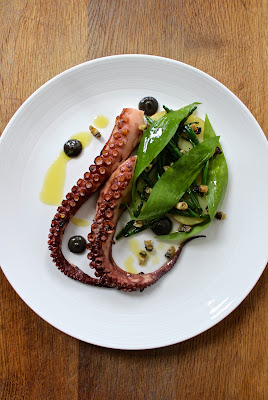
One ingredient that I haven’t rinsed is octopus. I probably on average cook one octopus a year, but that definitely needs to change. A more moreish, delicious thing I struggle to imagine. At work we sell a fair few of these lovable beasts every week, but mostly to Spanish or Italian customers who don’t blink at leaving the shop lugging a 3kg cephalopod behind them. The majority of others squirm, or pull a funny face at a glance! I guess they are slightly intimidating if you’ve never had a go at cooking one before, but you quickly learn how easy and satisfying the results are. Nevertheless, and slightly devastatingly, Katie really isn’t a fan, so I always have to try and steal an evening or afternoon when she is elsewhere before I can quench my octopus cravings. A sunny day last week provided the ideal opportunity…
Freezing food rarely improves it, but with octopus (octopi? octopuses? octopus?...) the process performs miracles. Traditionally to tenderise the firm, elastic flesh you would have to bash the living daylights out of it with a mallet, or flail it against the nearest rock. But after a quick stay in the freezer, all of this is done for you. All that is then required is a gentle simmer for just under an hour and it’ll be wonderfully soft. At this point it is ready to eat, and can be tossed through a salad, drenched in marinades or merely sliced and nibbled on at will, but I think that a quick exposure to a fierce heat really gets the best out of it. The deep, savoury, smoky flavour and crispy/soft combination is so addictive. I polished off the lot.
This is less of a hot dish, more along the lines of a warm salad; and as I discovered with the leftovers, is equally delicious cold. The longer that the lemon marinade gets to slosh around and permeate into the potatoes, samphire and octopus the better. And it’s a fact that a bit of mayonnaise will always make things better.
Serves 4
Ingredients:
For the octopus:
1 Mediterranean octopus, the double sucker variety, about 1 kg, cleaned
2 shallots, sliced
1 fennel bulb, sliced
2 garlic cloves
1 bay leaf
½ a lemon
1 large glass of white wine
For the squid ink mayonnaise:
2 sachets of squid or cuttlefish ink
2 egg yolks
1 clove of garlic, grated
1 tsp Dijon mustard
250ml olive oil
1 lemon, zest and juice
1 tbsp white wine vinegar
For the jersey royal potatoes:
4-6 medium-sized jersey royal potatoes, washed
2 lemons, juice only
1 large clove of smoked garlic, thinly sliced
3-4 tbsp extra virgin olive oil
For the winkles and samphire:
2 handfuls of live winkles, purged in salted water for at least 20 minutes
2 handfuls of samphire
1 lemon, juice only
To finish:
12 wild garlic leaves, washed
Start by braising the octopus. Put the octopus in a large saucepan along with the shallots, fennel, garlic, bay and lemon. Pour in the wine and top up with an equal amount of water. Bring to the boil, then cover and simmer very gently for 45 minutes, or until the octopus is very tender. Remove from the pan to a side plate and allow to cool, then remove the head and chop the tentacles into individual pieces.
While the octopus is cooking, boil the potatoes. Put the washed jersey royals into a saucepan and cover with cold, salted water. Bring to the boil and simmer for 15-20 minutes, or until cooked through. Drain well, then cut into thin slices and arrange in a bowl. Make the dressing by squeezing the lemon juice into a small bowl and adding the smoked garlic. Slowly but thoroughly whisk in the olive oil until emulsified, then season well with salt and pepper. Pour two-thirds of the dressing over the potatoes while they are still warm, then set aside.

Put the egg yolks for the mayonnaise into a small food processor along with the vinegar, mustard, salt, pepper, garlic and lemon zest, then blitz together well. With the motor still running, drizzle in the olive oil very slowly, until it is all poured in and the mixture has emulsified into a thick mayonnaise. Squeeze in the squid ink and the lemon juice and combine well again so that the dark colour permeates the whole mixture. Taste and adjust the seasoning, and loosen the texture with a splash of water if needed. Spoon into a plastic squeezy bottle and set aside.
Bring a small saucepan of well-salted water to the boil. When hot, add the winkles and boil for 3-4 minutes. Drain well, then use a fork to pick the meat out of the shells. Remove the dark stomach sacks and hard feet from each winkle. Heat a generous amount of olive oil up in a large frying pan until it reaches a low-medium temperature. Add a good splash of water, then add the winkle meat and the samphire. Warm through for a couple of minutes.
Heat a griddle pan up until smoking hot. Coat the octopus tentacles with olive oil, then cook for 2-3 minutes in total, turning once or twice, until lightly charred.
To plate up, arrange two of the octopus tentacles onto each plate, along with a few slices of the marinated potatoes. Dot on a good amount of the squid ink mayonnaise, and spoon some of the samphire and winkles on top of the potatoes. Finish with some of the wild garlic leaves and a drizzle of the reserved lemon and garlic dressing.
Winter seems like it is finally waning. Although those bright mornings still hide a nasty chill, there’s no supressing those green shoots in every park and garden. Ingredients long forgotten are creeping back onto the shelves of my local greengrocers, and my mum and dad excitedly tell me about all of the exciting produce that is coming to fruit at their allotment. I won’t lie, I look forward to the next time I leave their home not clutching yet another bag of sprouts and leeks.

This week I have teamed up again with Campo Viejo, who challenged me to come up with a recipe celebrating this change of seasons. Even on the telly recently, food programmes championing the spring have focussed on glamorous vegetables such as asparagus and peas. To me these aren’t true spring vegetables, and we’ve still got a little while before their seasons truly start. I think of proper old fashioned greens about now, leaves like chard, spinach and cabbages along with the seemingly ever-present broccoli. These all seem to take a lower-ranking, yet I wanted to create a dish that showed that they can be equally as delicious.
As ever my first place to look for recipe inspiration is my local greengrocers at Newington Green. It really is superb, and somewhere that despite moving half an hour away I still return to. On this occasion they had wonderful bunches of cime di rapa, greens that look like spindly, leafy broccoli. Although I had never cooked with them before I just had to have some. There was also a massive pile of wild garlic. Even though the hype surrounding this little herb gets to silly levels every year, finding it on every ‘trendy’ menu in town, it is always something that I look forward to eating. Old favourites of garlic, chilli and lemon were also purchased to bring the dish to life.
For a centrepiece to this warm salad of greens I decided on a globe of wonderfully smokey buffalo mozzarella. Although burrata seems to have stolen the thunder of mozzarella of late, I still think that good quality, creamy mozzarella is hard to beat. I wanted to take this a step further for this recipe by quickly giving it a blast of smoke. Both brassicas and cheese love a hint of bitter, charred flavour so this gentle smokiness helped round everything together. Being a longwinded cook by nature I did this in my garden at home, but if you are short of time or can’t be bothered, try any good Italian deli or cheese specialist.
Back to the wine. I felt that the smokey, earthy and creamy nature of the dish required a fresh accompaniment, so I decided to serve it with a glass of the 2012 Garnacha. This provided a light contrast, perfect on a gloriously sunny spring afternoon.
Serves 2
Ingredients:
For the mozzarella:
2 balls of smoked mozzarella (if you can’t find any, a good creamy buffalo mozzarella will do)
For the greens:
2 good handfuls of spring greens such as sprouting broccoli, spinach, cime di rapa or chard
½ a lemon, zest and juice
A sprinkle of dried chilli flakes
1 garlic clove, grated
For the wild garlic:
8-10 wild garlic leaves
A squeeze of lemon juice
A drizzle of extra virgin olive oil
To finish:
8 slice of lardo
A few glugs of extra virgin olive oil
Salt and pepper
If you are using thicker greens such are sprouting broccoli or the heads from the cimi de rapa it is nice to grill them. Preheat the grill to high. Arrange the greens onto an oven tray and toss with salt and pepper and a little oil. Grill for 4-5 minutes, until tender and slightly crisp and charred. Dress with a squeeze of lemon juice. Keep warm.
Bring a large saucepan of salted water to the boil. Blanch the leafier greens for 2-3 minutes or until just tender.
While the greens are simmering, heat a generous amount of the olive oil in a large frying pan. Gently cook the garlic, chilli and lemon zest for one minute. When the greens are ready transfer them into the frying pan using tongs and toss to combine.
Dress the wild garlic with a little lemon juice and olive oil.
Arrange the greens onto each plate around a ball of the mozzarella. Top with slices of the lardo and some wild garlic leaves. Finish with a squeeze of lemon juice, a drizzle of oil, some more chilli flakes and some salt and pepper.


