Showing posts with label local food. Show all posts

Monday, 5 September 2016

Cuttlefish, onions and lentils with samphire and clams


I’ve wanted to develop a recipe with cuttlefish for a long time now. At work, their peculiar and often very inky forms make an occasional appearance on the slab, but due to the sporadic nature of their availability, until now I haven’t quite managed to steal the right moment. And I thought that this summer would be very much the same, and instead I’ve been largely (and very happily) feasting on its close relations, the octopus and the squid. So when I opened a box one sunny morning a few weeks ago and was greeted by pile of particularly fine specimens, I just knew I had to take some home and fire up the hobs. 


Cuttlefish is definitely something that we should be eating more of in this country. But unlike squid or octopus that are well and truly pinned onto the food map, cuttlefish gets all the bad press. That is, no press at all. Admittedly as a fishmonger they can be a bit of a nightmare due to their tendency to be messy and time consuming to prepare. But often it doesn’t even reach that point, with customers going down the safe old salmon, cod and tuna route. With the prices of these prime fish soaring, the cuttlefish still carries an unfashionable price tag, has bags of flavour and is a doddle to cook. All it needs is a decent national PR spin…  

This dish represents exactly the type of food that I love to eat as we slide into Autumn with a chilly wind and grey cloud of rain. Slow, easy cooking that is all about the development of flavour over a little patient simmering. Food that can be sliced and eaten with a spoon. Now we’re in September, the shellfish will start to get slightly stronger, and soon we’ll see Shetland mussels back in their prime. Samphire is slowly heading the other way, and I’m finding any excuse to introduce a handful into my meals. Before long that vibrant green will be replaced by the burnished oranges and reds of squashes, apples and corn. I can’t wait.   

Serves 2 for a main, or 4 for a lunch or starter 

Ingredients:  

2-3 small cuttlefish, cleaned, with the tentacles and ink sacs reserved 
1 onion, finely sliced 
2 cloves of garlic, grated 
1 tsp fennel seeds 
1 tsp dried chilli flakes 
1 tsp dried oregano 
1 glass of white wine 
500ml chicken stock 
2 sachets of cuttlefish ink 
¾ of a mug of firm lentils, such as Puy 
1 lemon, juice and zest 
1 small bunch of parsley, finely chopped  

To finish:  

12-15 clams 
A handful of samphire 
The tentacles from the cuttlefish, cut into 3 or 4 pieces


Slice the cleaned and skinned body and wings of the cuttlefish into chunky centimetre-thick strips. Pour a generous glug of olive oil into a large saucepan and bring up to a medium-high temperature. Fry the cuttlefish for 3-4 minutes, turning occasionally, until they start to turn golden. Season well. Turn the heat down slightly and add the onion, garlic, fennel seeds, dried chilli and oregano. Continue to fry everything together for a couple of minutes, stirring occasionally, until the onions soften slightly. Turn the head back up and pour in the wine. Allow the liquid to bubble away and reduce by half. Stir in the ink from the sachets, and carefully squeeze in the ink collected from the cuttlefish sacs (use an extra two sachets if you can’t collect them). Stir well, then top up with the chicken stock. Bring back to the boil, then turn down to a very gently simmer. Cover the saucepan with a lid and cook for 30 minutes. 


After 30 minutes, pour the lentils into the saucepan and stir everything well. Continue to simmer for a further 30 minutes.  

Bring a frying pan to a high heat and pour in a good glug of olive oil. When the pan is very hot, add the cuttlefish tentacles and a good pinch of seasoning. Fry for 2-3 minutes, turning once, until golden and slightly crispy. Remove from the pan onto a plate lined with kitchen paper to drain. Keep warm.  

Bring a saucepan to a high heat. Add the clams and a small splash of water. Seal the pan tightly with a lid, and cook for 3-4 minutes, until the clams all open. Turn the heat down and stir in the samphire. Cook for a further minute, then remove from the heat. 


Finish the lentils by stirring in the parsley and squeezing in the lemon juice. Taste and add more seasoning if needed.  

To serve, spoon the lentils and cuttlefish into shallow bowls and top with the samphire, clams and crispy tentacles. Finish with a scattering of the lemon zest and a good drizzle of extra virgin olive oil.

Monday, 23 September 2013

Slow-cooked chuck steak ragu with pappardelle, girolles and sage leaves


The relationship between food and family and friends is extremely close and important to me. Growing up as part of a large family, my parents would often be busy cooking two or three different meals per evening for fussy children of different ages, and then finally themselves. Despite this, they always made sure that we all sat down and had dinner together at least 4-5 times a week, and this is something that I will be very keen to pass down when I am a father. Most of my memories involve food. Big family Sunday roasts with steaming joints of chicken. The day my dad called me to the kitchen to make me try a mussel he was cooking for a dinner party (I hated it!). Gazing through old cookbooks with my mum, and really wanting to make the cake that was a house in the shape of a boot, complete with a shredded wheat roof. Thinking about these times fills me with a warmth and happiness. Food is so much more than a fuel to keep us alive, it binds us socially, creates atmosphere and inspires. The wafting smell of bread baking in the oven does so much more than just produce a loaf for toast. 


As I have grown older this bond between food and my social life has become stronger. Nowadays I love nothing more than having friends over for a good meal and a glass or two of wine. I enjoy going out to nice restaurants and eating fancy food where every ingredient intrigues, but my fondest meals are ones where the food is a background constant to bustling conversation. For this kind of occasion, cooking should not dominate; I don’t want to be stuck in the kitchen away from my friends. But that doesn’t mean that it can’t be good, it just needs to be approached in a different way.


On this occasion a few weeks ago, a couple of old friends were coming over for dinner. At first I was just going to knock together a simple but tasty one pot supper, something casual to plonk on the table for everyone to help themselves. This was thrown out the window the day before however, when they told me that they had seen this blog, and they had high expectations of what they would be served. This presented me with a challenge, as I had to try and create something impressive that was practical socially. All those memories of dad making his dinner party staple of salmon en croute came flooding back!


Salmon was not on the menu for me however. I love making pasta, and the thought of a slow-cooked, meaty ragu sauce was too much to resist. This ticked all of my worry boxes; the homemade pasta and flavoursome sauce would please my guests, and I would be able to make the whole thing in advance.


I know that in the last month I have cooked beef a lot, with a tartare, a Wellington and now a ragu, but for this meal it worked perfectly. My only dilemma was the cut to use. Ideally I would have used something with bags of flavour like cheek, shin or oxtail. But as it was a Sunday and I had limited time on my hands, I left the butchers with a whopping piece of chuck. This is the joy of local, independent butchers; you can really talk to them about what you want to cook, and they have the wealth of knowledge to advise. So although they didn’t have the cuts I was looking for (but would have been able to order with a few days notice), I left with something that was still bang up for the job.


Britain has some wonderful mushrooms, and a quick gaze at this blog will tell you that I am obsessed with them. I am lucky that my local greengrocer has a wide range, and I really recommend searching in local food markets. But if you can’t get hold of girolles, then meaty, strong mushrooms such as chestnut or portabella will also work well.


Lots of this preparation can be done days before it is needed, and aside from the pasta, requires very little time. The sauce itself gets better over time, and any leftovers are great with potatoes or as a pie filling.


Serves 6-8


Ingredients:


For the pasta:


600g strong ‘00’ grade flour

6 eggs
1 tbsp salt
2 tbsp olive oil

For the ragu:


1.5kg chuck steak, cut into 2-3” chunks

200g plain flour
2 onions, finely chopped
1 head of garlic, chopped in half
2 celery sticks, finely chopped
2 carrots, finely chopped
200g button mushrooms, sliced
2 bay leaves
10 sprigs of thyme
2 sprigs of rosemary
½ bottle of red wine
1.5ltr good beef stock
Salt and pepper 


6 rashers smoked streaky bacon, finely chopped
2 shallots, finely chopped

50g butter, cubed
40g pecorino, finely grated

For the sage leaves:


About 30 sage leaves

3-4 tbsp vegetable oil, for frying

For the girolles:


About 30 girolle mushrooms, cleaned and trimmed

30g butter
½ clove garlic, finely chopped
Salt and pepper

To finish:


Grated pecorino

Extra virgin olive oil
Pepper


Get the ragu going to start with. Tip the plain flour onto a plate and season well, then use this mixture to lightly dust the chuck steak. Heat up a large, heavy bottomed saucepan to a high temperature and add 2 tbsp of oil. Cook the meat in batches, searing quickly until well browned on all sides before removing to a plate. When all of the meat is cooked, add the onions and celery. Sautee for a couple of minutes until coloured, then add the carrots, garlic, mushrooms and herbs. Continue to cook for another 2-3 minutes then pour in the red wine. Bring to the boil and allow to reduce slightly, then put the meat back into the pan. Cover with the stock, topping up with water if needed. Season well and bring back to the boil then turn down to a simmer. Cover with a lid and cook for about 5 hours, until the meat is falling apart. 


While the ragu is cooking, make the pasta. Add the flour, eggs, salt and oil to a food processor and blend until the mixture resembles coarse breadcrumbs. Tip out onto a clean surface and pat together, then knead well for 10-15 minutes. The dough should be soft in texture but not sticky. Wrap well in cling film and put in the fridge to rest for at least half an hour, preferably longer.

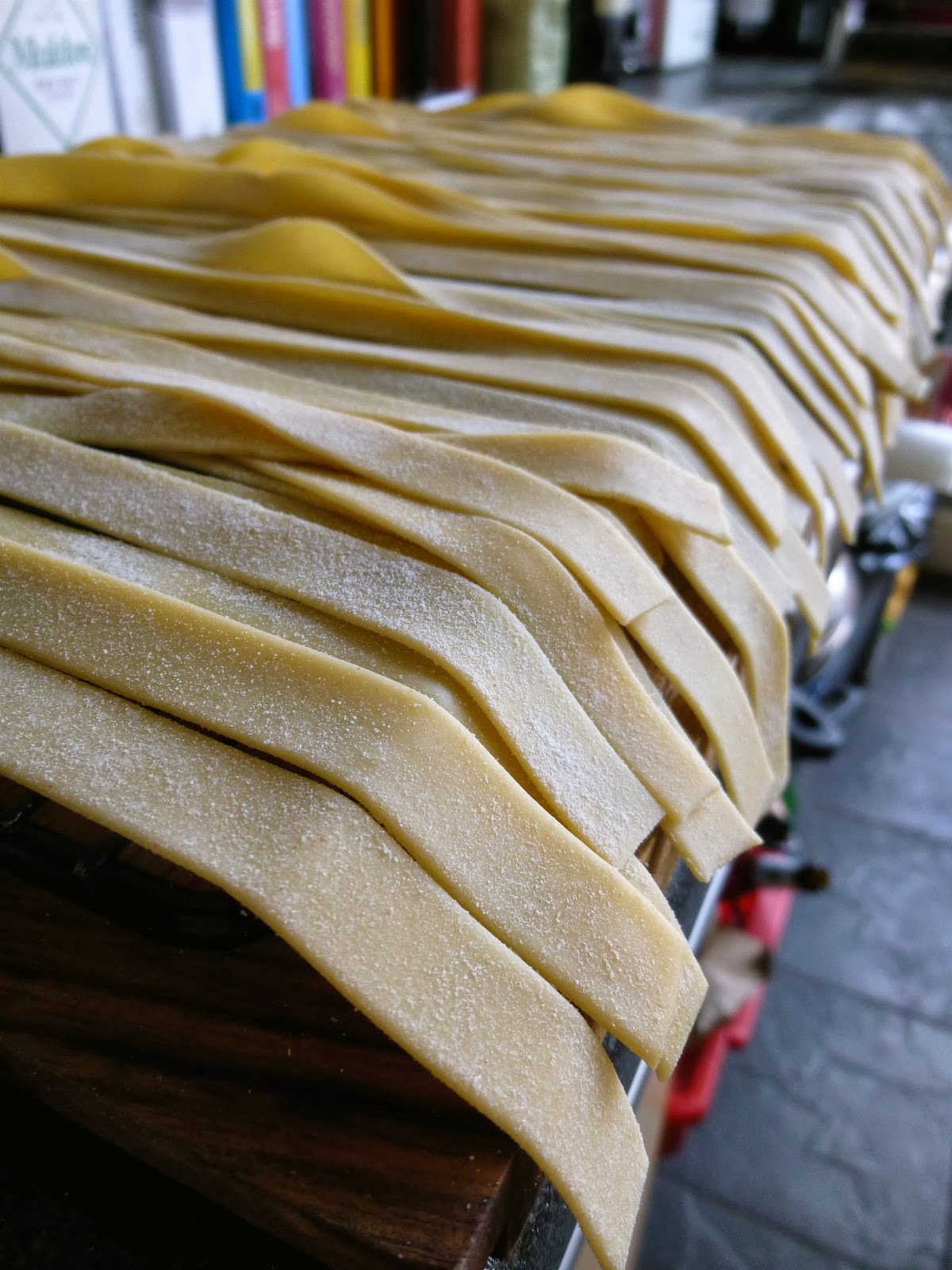
When the dough has rested, remove it from the fridge and cut it into four pieces. Dust with a little flour, then pass one piece through the widest setting of a pasta machine. Repeat 7-8 times, or until the dough has a really elastic texture. Rub with a little more flour if it starts to turn sticky at this point. Now roll the pasta down through each setting on the machine you get to the second thinnest; number 5 on an Imperia machine. Sprinkle the outside of the sheet with flour, cover with a clean tea towel and repeat with the other pieces of pasta dough. Cut the sheets to the length that you want the pappardelle to be, then pass through the pasta cutter. Dust a cooling rack with flour and lay the individual strands down to dry. Keep the pasta separate and in one layer to avoid sticking. 


To prepare the sage leaves, pour the oil in a small frying pan and put on a medium-high heat. When hot, add the sage in batches and cook for 20-30 seconds, or until crispy, then remove to a plate lined with kitchen roll. Set aside until needed later.


After 5 hours, carefully remove the meat and a little of the liquid to a bowl and allow to cool. Once cold, finely shred the meat and set aside. Strain the remaining stock from the saucepan through a sieve into a large bowl and discard the cooked vegetables. Set a large, high-sided frying pan or skillet onto a medium-high heat and add a little oil. Add the bacon and cook for a couple of minutes until starting to colour, then add the shallot and fry for another 2 minutes. Now pour in the strained stock. Turn the heat up and allow to reduce by at least half, until just enough is left to hold the shredded meat. Turn down to a simmer and add the meat, combining well so that the sauce and meat come together as one. Taste and season if necessary, then turn the heat right down until needed. 


Fill a large saucepan with well-salted water and bring to the boil.


While the water is boiling, raise the heat of the ragu sauce pan to a simmer.


When the water boils add the pasta. Cook for 1-2 minutes, until just al dente.


While the pasta is cooking, add the cubed butter and grated pecorino to ragu sauce and stir well to combine. Taste and add salt and pepper if needed. As soon as the pasta is cooked, use tongs to transfer the pappardelle to the pan with the ragu and toss to combine well, so that every strand is coated. Remove from the heat.


Heat up a medium sized frying pan to a moderate temperature and add the butter for the mushrooms. Fry the garlic for 30 seconds then add the prepared girolles, cooking for another couple of minutes until crisp on the outside and soft in the middle.


To plate, spoon a generous amount of the pasta into bowl and top with some of the girolles and sage leaves. Grate over some more pecorino, grind some black pepper and drizzle a little extra virgin olive oil.

Monday, 18 February 2013

Crispy and poached oysters with oyster and leek veloute, pickled cucumber and lemon and tarragon oil


Last week I had a few days off work on holiday, but used this time to really relax with no plans to travel anywhere. Instead I just had a lovely enjoyable few days pottering around London and cooking. It was really nice to get out and visit some of the cracking local independent food suppliers that are normally closed when I get my days off on Sundays and Mondays. 

On Tuesday I took the bus down to Victoria Park where I placed an order with brilliant fishmonger Jonathan Norris. He is someone who I have spoken to many times on Twitter, mostly for help about what is in season etc, but it was great to finally pop in and say hello in person. Since I moved to Stoke Newington I haven’t been down to the area too often, but Katie used to live in Victoria Park and I really do love it round there. I’ve many happy memories of ogling at sausage rolls in the window of the Ginger Pig and breakfasting by the lake at the park pavilion. It’s such a foodie hub and you can get nearly anything in that tiny handful of shops. 


On this occasion I had ordered oysters. Now I am the first person to put my hand up and say that I’m not wild about eating raw oysters. It’s not the taste, I’m just not too keen on the texture, and they’re not something that I take that much pleasure from eating. But like I said about bone marrow in the previous blog post, I’m sure that this is a transitional thing and I will end up eventually liking them. But in the meantime, I know that there are other things that you can do with them and I was determined to make something nice. I liked the idea of gently cooking them with a creamy, chowder like soup.

I thought that this would also be a good occasion to have a go at making a veloute. It’s always something that I’ve associated with fine dining and have been nervous to attempt to make this super smooth, decadent soup. For Christmas I was fortunate to be given a number of great cookbooks, including the huge and insanely good Square Cookbook by Philip Howard. I knew that oyster veloutes existed, and when looking through the index for pointers I was pleased to see that there was a recipe for that very thing. I have used the veloute recipe in that book as the base for the one I made here, although Phil used his as part of an amazing starter with eel, salt cod and caviar. I haven’t quite gone that far here, simply deep frying some oysters to contrast the texture and adding some lightly pickled cucumber to give the acidity that is much needed in this creamy dish. 


Freshness is of the utmost importance when it comes to oysters. I would only really eat them on the same day as buying them, and only from a decent fishmonger. This is the joy of getting to know good local food suppliers, as you can learn loads about seasonal food and really trust that the produce that you get is top quality; a far cry from the majority of supermarkets. 

Serves 2 

Ingredients:

For the crispy oysters:

2 oysters
1 small handful panko breadcrumbs
1 egg
2 tbsp flour
Salt and pepper
Vegetable oil for deep frying, about 1 litre

For the poached oysters:

4 oysters

For the veloute:

3 medium leeks, finely sliced
1/2 onion, finely sliced
1/2 floury potato such as maris piper, finely sliced
30g butter
500ml water
250ml whole milk
1 large tbsp creme fraiche
8 oysters

For the pickled cucumbers:

1x 3” piece of cucumber
100ml white wine vinegar
3 tsp sugar
5 black peppercorns

For the lemon and tarragon oil:

100ml olive oil
1 small handful tarragon
1 lemon, zest only

For the sauteed leeks:

1/2 a leek, julienned into thin 2” sticks
1 large knob butter
Salt and pepper

Firstly make the lemon and tarragon oil. Put the oil, tarragon and lemon into a small saucepan and gently warm up, but not enough to start frying the flavourings. Turn off the heat, cover the pan with clingfilm and leave to cool down and infuse. Transfer to a squeezy bottle and set aside. This is best done a day in advance to let the flavours mix into the oil. 


To make the veloute, heat the butter in a large saucepan on a medium heat. Add the leeks, onion, potato and seasoning and cook for 6-7 minutes, until softened. Pour in the water, bring to the boil and simmer for 20 minutes. Add the milk and creme fraiche and bring back to boil then pour the liquid through a sieve into a bowl. Spoon about a quarter of the leeks, onion and potatoes into a food processor with the strained liquid and blend really well until very smooth. Discard the remaining leeks. Strain again and set aside to cool. This part can be done in advance. 

While the veloute is cooking, make the pickled cucumbers. Peel the piece of cucumber and cut in half, then scrape out the seeds with a spoon and discard. Carefully cut into an even fine dice and put into a small bowl. Pour the white wine vinegar into a small saucepan with the sugar and peppercorns. Bring to a simmer and cook until the sugar has dissolved. Remove the peppercorns and pour over the cucumbers. Mix well with a spoon and set aside to cool. 


Julienne the leeks for the garnish and fry gently for 10 minutes in the butter and a little seasoning until softened. Keep warm and set aside.

Heat the frying oil up in a heavy medium saucepan to 170ÂșC. 

Slowly reheat the veloute up to just below boiling. 

Fill a small saucepan with salty water and bring to the boil.

To make the crispy oysters, set up two small plates and a bowl. Beat the egg into the bowl and put the panko and flour respectively on the other two plates. Season each part. Open two of the oysters, keeping them as intact as possible and draining the liquid. Gently roll the oysters in the flour, then dip into the egg before moving to the breadcrumb plate and covering. 

Open the 8 oysters for the veloute and put into the food processor.

Open the 4 remaining oysters for poaching. 


When the oil is hot, water boiling and veloute up to temperature it is time to finish the dish. Put the 4 oysters into the boiling water, reduce the heat to a simmer and cook for two minutes. At the same time, lower the coated oysters into the hot oil and deep fry, turning occasionally until golden brown, about a minute. While this is happening, tip the veloute into the food processor over the oysters and blend really well until combined and frothy. Taste and season if needed. 

To plate up, make a little mound out of the cooked leeks and place in the middle of the bowls. Pour some of the veloute in and position the poached oysters in the ‘moat’. Spoon a little of the pickled cucumber around each side and put the crispy oysters on top of the leeks. Drizzle a bit of the lemon and tarragon oil around the bowl and serve quickly.