Showing posts with label Autumnal recipe. Show all posts

Thursday, 17 September 2015

Roast pigeon with prosciutto, sweetcorn, sage and onions


The days that I spend cooking for this blog are often hurried and frantic affairs. In the mornings I’m out and about gathering the required ingredients, before returning back home to turn them all into a finished (and hopefully successful) dish. In theory a fairly simple and straightforward plan. But often enough something goes amiss and the whole ordeal becomes much more stressful. Especially for something meant to be a hobby. And last week was a prime example. 


Things didn’t get off to the best of starts; I overslept. This wasn’t the greatest of problems really, and in truth Mondays are also my only real day of the week to get some rest. But it set me behind schedule, and my window for messing about in the kitchen was getting smaller and smaller. What I really wanted to buy was a grouse or two. Since the Glorious Twelfth, my social media feeds have been jam-packed with them, and I wanted to have another crack at cooking them. But could I find one? Could I heck. A few tubes and buses covering a London map of butchers later and I still had empty bags and even less cooking time. Stuck on Oxford Street amongst the crowds, things were looking pretty desperate. But then I remembered that there was a rather good branch of the Ginger Pig, not too far away in Marylebone, so I walked up to chance my luck one more time.
 
They also didn’t have any grouse. Bah! But what they did have were a couple of lovely, plump pigeons. At that stage of the day, I snapped them up. With the recipe cogs whirring around in my head, I darted next door to the mecca that is La Fromagerie for some bits to accompany the bird, and I was soon sat on the bus home with a bag laden with beautiful sweetcorn, cavolo nero and prosciutto. Soon the light would be fading, threatening rubbish photography and a wasted day, so I had to work quickly.
 
I wasn’t too disappointed to be lumped with pigeon instead of my desired grouse. I haven’t tackled a pigeon for a good few years, but they remain one of my favourite things to eat. I love that gamey richness and tender, pink flesh. And because the birds were whole, literally heads, claws and guts, it meant that I also had access to the wonderful offal. Whilst the trimmings and liver helped to make the sauce deep and flavourful, the heart was simply pan-roasted, adding another dimension to the finished dish. I never mess around with the cooking of smaller poultry, in my opinion roasting the crowns before carving is the only way to go.
 
The rest of the dish is a simple balance of early autumn flavours. The sweetcorn provides a wonderful sweetness that cuts through the powerful flavour of the pigeon. Sage and onion are practically married. I’ll still try and track down a grouse this season, but in the end I was pleased as punch with my pigeon.
 
Serves 2
 
Ingredients:
 
For the pigeon:
 
2 pigeons, portioned into crowns with wishbones removed. Trimmings, hearts and livers kept 
4 slices of prosciutto 
4 sprigs of thyme 
2 sage leaves 
1 knob of butter
 
For the sauce:
 
The wings, legs, livers and trimmings from the pigeons 
1 onion, finely chopped 
1 carrot, finely chopped 
2 garlic cloves, crushed 
2 slices of prosciutto, chopped 
5 sprigs of thyme 
1 generous splash of brandy 
750ml good chicken stock 
1 knob of butter
 
For the smashed sweetcorn:
 
The kernels from 2 sweetcorn cobs, released with a knife 
75g butter 
500ml water
 
For the charred sweetcorn:
 
The kernels from 1 sweetcorn cob, released with a knife 
1 small knob of butter
 
For the burnt onion:
 
1 small onion, skin left on and halved vertically 
½ a lemon, juice only
 
For the cavolo nero:
 
3-4 cavolo nero leaves, any tough stalks removed, leaves roughly chopped
 
For the pigeon hearts:
 
The hearts from the two pigeons, cleaned of any sinew

 
Get the pigeon sauce on first. Bring a large, heavy frying pan up to a medium-high temperature and add a good glug of olive oil. Season the pigeon legs, wings, trimmings and livers with salt and pepper and brown well on all sides, in batches if necessary. Add the prosciutto, onions, carrots, garlic and herbs to the pan and cook until lightly caramelised. Pour in the brandy and carefully flambé, then reduce until only a small amount remains. Top up with the chicken stock and bring to the boil. Use a wooden spoon to scrape up and caramelised bits from the bottom of the pan. Reduce slowly until only around 150ml of thickened sauce remains. Strain the sauce through a sieve into a smaller saucepan and discard the used flavourings. Whisk the knob of butter into the sauce until fully emulsified, then cover and set aside until needed later. 


Bring a frying pan up to a high heat and add a small amount of olive oil and a knob of butter. When hot, add the smaller amount of sweetcorn kernels and a good pinch of salt and pepper. Fry for a few minutes, stirring frequently, until starting to brown and blacken. Tip into a bowl and set aside.
 
Pour the water for the smashed sweetcorn into a saucepan and bring to the boil. Tip in the sweetcorn kernels, butter and a good amount of seasoning. Stir to combine, then simmer for 8-10 minutes, or until the sweetcorn has softened and taken on some of the liquid. Using a hand blender or food processor, blitz into a coarse, yet soft mash. Loosen with a little water if necessary, and taste for seasoning and butter. Cover and keep warm. 


Add a good glug of oil to a frying pan and set on a high heat. Place the onion halves cut-side down and fry for 5-6 minutes, until blackened and burnt. Turn over for an additional 5 minutes, then transfer to a side plate. When cool enough to handle, carefully separate the layers into little cups and place in a bowl. Squeeze in the lemon juice and season. Mix well and set aside.
 
Preheat the oven to 190⁰C.
 
Pour a generous glug of olive oil into a large, heavy frying pan and bring to a medium-high heat. When hot, add the sage leaves and fry for 30 seconds until crispy. Transfer to drain over a sheet of kitchen roll. Keep the pan hot for the pigeons.
 
Season the insides and outsides of the pigeons well with salt and pepper. Lay the sheets of prosciutto crisscrossed over the breasts, tucking some sprigs of thyme and a sage leaf underneath. Tie in place with some kitchen string. 


Add a large knob of butter to the sage pan and sear the pigeons for 1-1.5 minutes on each breast. Turn the crowns so that they are sitting upright in the pan, and use a spoon to baste well with the butter for a further minute. Transfer to an oven dish and roast for 10 minutes. Allow the cooked birds to rest for 10 minutes, then carve the breasts from the bone.
 
While the pigeons are resting, cook the pigeon hearts. Bring the same pan that was used to sear the pigeons back to a medium-high heat. Season the hearts, then cook for 1 minute on each side, basting well. Remove and allow to rest briefly, then slice in half.
 
In the same, now empty pan, add the cavolo nero leaves and a good splash of water. Wilt down quickly for a couple of minutes until tender.
 
Reheat the sauce and the smashed corn.
 
To plate up spoon a few dollops of the smashed corn onto each plate and add some of the cavolo nero. Arrange the pigeon breasts in the middle and three of the onion segments in the gaps at the sides. Top with the charred corn, heart, sage leaves and some of the prosciutto from the pigeon. Spoon some of the sauce into the onion cups and around the plate and serve.

Friday, 14 November 2014

Roasted pumpkin soup with braised duck leg, girolles, toasted chestnuts, duck crackling and taleggio

In the last month Katie and I have moved from the original tiny Sam Cooks Food flat slightly east to London Fields. Although I enjoyed Stoke Newington and have plenty of fantastic memories, one of the things that I will miss the most is the amazing greengrocers that we had close by. This blog really wouldn’t be the same without it. That shop was a constant influence, and the sheer range of interesting fruit and vegetables meant that after every visit I often left with three or four new recipe ideas flying around my head. They were the place to go when searching for that springtime wild garlic, for those vibrant heritage carrots or the sweetest of summer tomatoes. I really was like a kid in a sweetshop there. Mum must approve that I’ve grown up to consider greengrocers like sweetshops.


I was up early one crisp morning, and having a day-off ahead of me I wrapped up and took a stroll back to my old haunts, planning to pop by the greengrocers to get a few bits to make a simple warming soup upon my return. I was taken instantly by the vast array of handsome pumpkins and squashes piled up outside, and immediately the old recipe cogs started working away. The comparison between the produce available at the supermarkets when compared to the smaller, specialist shops always amazes me. If I went to the former I would be limited to your standard Cinderella bulbous orange types or the old faithful butternut squashes. But that morning about a dozen variants were on show, some tiny, some speckled, some that looked like two totally different pumpkins fused together. I just had to get one. I changed my mind and bought two. And somehow upon my return home I had also acquired some lovely mushrooms, a pair of duck legs and a honking chunk of taleggio.
 

I really love the autumn, and living close to London Fields I’m lucky enough to be treated to the glorious spectrum of burnished gold and orange on a daily basis. The food is also at its most dramatic and striking, with gourds, corn, beets, apples and chestnuts all on the seasonal menu. Gone are the sea of green spring and summer vegetables and the light, refreshing dishes they abounded. For the next few months it is all about hearty, filling food; the sort that makes a day spent in the cold forgotten within seconds.
 

Soup is a year-round thing in our household and is always savoured. They are marvellous things, often loaded with all of those vegetables that my body screams out for after a few heavy nights out or a tough week at work. It always shocks me that lots of my friends still hold a stigma against the humble soup, not deeming them worthy as a standalone meal option. Well more fool them, they clearly haven’t had a steaming bowl of tomato soup with triangles of cheese and bread on the side. Heaven. I just like the creativity that they allow. On busy days a few chunks of root vegetable floating in a bit of stock will suffice, but the variety of little finishing touches is almost limitless. This recipe is very much in this thinking; the base is a simple yet delicious roasted pumpkin soup that stands up for itself. But this is only made more interesting with the different textures and bursts of flavour from the garnish.
 

Serves 4-6
 

Ingredients:
 
For the pumpkin:
 

1 medium pumpkin, peeled and seeds removed and reserved
1 tbsp smoked paprika
1 tsp ground cinnamon
1 tsp dried chilli flakes
1 tbsp dried oregano
1 lemon, zest only
3 garlic cloves, grated
5 sprigs of thyme, leaves picked
3 tbsp olive oil
 

For the duck and stock:
 

2 duck legs, skin removed and reserved
1 glass dry white wine
1 litre good chicken stock
1 leek, sliced
1 carrot, chopped
2 shallots, sliced
3 garlic cloves, crushed
2 tomatos, diced
1 tbsp smoked paprika
1 tbsp dried oregano 

5 sprigs of thyme 
1 bay leaf
 

For the chestnut, leaves and duck skin:
 

3 fresh chestnuts, peeled and thinly sliced
The reserved skin from the duck legs, cut into small pieces
The seeds from the pumpkin, cleaned of membrane
3 thyme sprigs
½ tbsp. dried chilli
½ tbsp. dried oregano
 

For the mushrooms:
 

12 girolle mushrooms, brushed clean
 

To finish:
 

100g taleggio cheese, torn into small pieces
Fresh oregano leaves
1 lemon, zest only 

Extra virgin olive oil


Pour a little olive oil into a large saucepan and set on a high heat. Season the duck legs and quickly brown on all sides, then transfer to a side plate. Tip in the leek, shallot, carrot, garlic, thyme, oregano, paprika and bay and sauté for about 5 minutes, then pour in the wine. Reduce by half then top up with the stock. Tip in the tomatoes and return the duck legs in the pan, making sure they are covered by the liquid. Bring to the boil, then turn to a low simmer. Partly cover and cook for 1.5-2 hours, or until the duck is very tender. Remove the duck legs from the pan and allow to rest in a little of the liquid for 10 minutes, then strip off the meat into small pieces and set aside. Strain the stock, discarding the vegetables. 


Preheat the oven to 200⁰C.
 

While the duck is cooking, cut the peeled and seeded pumpkin into 1.5” chunks and scatter in one layer onto an oven dish. Mix all of the other ingredients and a good amount of seasoning in a bowl, then pour over the pumpkin and toss until each piece is well coated. Roast in the oven for about 45 minutes, or until lightly caramelised on the outside with a soft core, turning every so often.
 

For the crispy seeds, duck crackling and chestnuts, pour a couple of tablespoons of olive oil into a frying pan and heat to medium-high. Fry the skin, chestnut slices and seeds with the herbs, spices and seasoning for a few minutes, or until crispy and golden brown. Transfer to a plate lined with kitchen paper and drain well.
 

When the pumpkin is cooked, transfer to a food processor and blitz really well. Slowly add the strained duck stock to the puree, continuing to mix until a smooth soup consistency is achieved. Taste and adjust the seasoning if necessary. Pour back into a saucepan and bring to just below the boil.


While the soup is heating up, pour a little olive oil into a small frying pan. When at a medium-high heat, fry the girolle mushrooms for a couple of minutes or until caramelised on the outside and cooked through.
 

To serve, place bits of the braised duck leg into each bowl and cover with the hot soup. Scatter over the crispy duck crackling, seeds and chestnut along with the pieces of taleggio, cooked girolles and fresh oregano leaves. Grate over a little of the lemon zest and finish with a drizzle of extra virgin olive oil.

Monday, 10 November 2014

Smoked haddock with pressed potato and leek, clam beurre blanc, charred corn and mussels


Gosh it’s been a while. The last few weeks and months have been a total blur, filled with the arduous and always-underestimated task of moving flat followed closely by the less arduous and highly anticipated task of a few weeks away in Sydney. With work and random jetlag tiredness to navigate around these goings on this blog has been shamefully put on the back shelf, until now! Despite being slow on the keyboard my cooking has continued and I’ve got a whole host of recipes to post over the next few weeks, from soothing cheesy pumpkin soups to rich, gamey mallard. 


This recipe makes me especially happy though as it is my 100th post on Sam Cooks Food. I’m really proud to have stuck with it and got this far; it seems like ages ago that I took the photos of that mushroom and goat’s cheese ravioli just over two years ago. I feel I’ve come on leaps and bounds since nervously typing that first recipe, both as a cook and writer. This blog has also been a source of stress relief, somewhere where I can vent or reflect on memories. It has been a place to celebrate birthdays and family gatherings and help me through personal struggles such as the death of my brother at the end of last year. It’s lead to numerous friends, writing opportunities, new jobs and collaborations with producers, and I was over the moon when The Evening Standard named it in their Top 20 London Blogs. On a practical level it drives my cooking level and food interest higher and higher. I used to be a stickler for recipes and was scared of venturing off-course, whereas now I take inspiration from something my parents have grown on their allotment or a cookery programme on the television and have a go at making something new. 
   
I had loads of ideas for what I wanted to make for this post. My first thought was spaghetti bolognese, something that has been somewhat of a cooking nemesis over the years. I still vow to correct my failings in this standby Italian and student classic in the future but for now it just didn’t fall into place. My mind was elsewhere and the wonderful autumnal seasonal food drove my cooking in other directions. Surely I can knock up a spag bol anytime? Well we’ll see. I also toyed with the idea of oysters, a true celebration ingredient, and made a delicious dish which is now patiently waiting in the wings for me to get around to and write. But as is often the case, what I was looking for was hiding in plain sight right in front of me. 
   
As the weather cooled and summer turned into a burnished chill, there were two things that I really started to crave; smoked haddock and sweetcorn. Two flavours that come together to form something so utterly soothing and comforting. Of course, my first instinct was to make chowder. This is something that my dad has long been the master, and he often makes huge batches at home in Brighton, steaming and ready after a blustery walk by the sea. It’s the sort of food that steams your glasses and exfoliates your cheeks, the sort that you eat until you full to bursting. It always seemed like such a difficult thing to cook, and before my food interest intensified I’d nag him again and again to show me how. Finally he bowed to my pestering, only for me to storm off in disgust after he cut himself. I was a moody teenager. Yet it’s still one thing that holds such a strong food memory. 
   
Here I have taken all of the components and flavours of the standard chowder and have given it my own stamp. Yet when you taste everything together I’m still taken back to family meals shared over the years. From cooking on a daily basis I also love how I keep on learning little unexpected things. On this occasion it was hard fried sweetcorn with butter and cayenne. It’s nothing new really, chilli butter has long been an accompaniment to corn on the cob. But it’s something that I’ve never really had before and an instant addiction. I could eat a bowl of that alone. 
   
Serves 2   

Ingredients:   

For the haddock:   

4 pieces of naturally smoked, undyed haddock, about 80-100g each, skin removed and reserved 
1 knob of butter 
1 tbsp olive oil 
½ lemon, juice only   

For the pressed potato:   

6 large maris piper potatoes, peeled and cut into thin slices 
1 leek, finely sliced 
1 clove of garlic, grated 
1 bay leaf 
1 knob of butter 
5 sprigs of thyme, leaves picked 
300ml single cream 
150ml milk 
(You may need a little more or less cream and milk depending on the size of your dish)   

For the shellfish and clam beurre blanc:   

1 handful live clams, rinsed 
1 handful live mussels, de-bearded 
1 glass of dry white wine 
150g cold butter, cut into 1cm chunks 
½ a lemon, juice only   

For the charred sweetcorn:   

1 cob of sweetcorn, kernels cut off and core kept 
1 knob of butter 
1 tbsp olive oil 
1 tsp cayenne pepper   

For the haddock skin:   

The skin from the haddock 
Salt   

To finish: 
   
Nasturtium leaves 

 
Preheat the oven to 180⁰C. 
   
To make the pressed potatoes, pour the milk and cream into a saucepan and add the used cob from the sweetcorn and the trimmings from the leek and garlic. Bring to a simmer then take off the heat. Add the butter to a separate saucepan and heat gently. Add the garlic, thyme and leek and sweat until softened. Line the bottom and sides of a deep oven dish approx. 20cm x 30cm in size with greaseproof paper. When the leeks are cooked, layer the potato slices into the oven dish, evenly distributing a little of the leek mixture and a good amount of seasoning at the same time. Strain the cream mixture and pour the liquid over the potatoes until nearly covered. Put another sheet of greaseproof paper over the top of the potatoes, then place another dish on top. Fill the top dish with heavy items such as baking beans, rice etc. to weigh the potatoes down. Bake in the oven for 30-40 minutes, or until the potatoes are tender and all liquid has been absorbed. Allow to cool, then refrigerate for at least 2 hours. 


For the haddock skin, line a baking sheet with greaseproof paper and rub with a little olive oil. Season the haddock skin lightly on both sides and lay on top, then place more on paper and another tray. Bake for about 20 minutes at the same oven temperature as the potatoes, or until crisp. Break into rough shards and set aside. 
   
Heat a frying pan to a high temperature and pour in the oil for the corn. When hot, tip in the kernels along with some seasoning and the cayenne and fry until they start to char. Stir in the butter and continue to cook for another minute, then transfer to a bowl and set aside. 


When the pressed potato has cooled down, remove from the fridge and slice around the sides of the dish. Carefully tip out onto a board – it should have compacted and stuck together. Using a sharp knife, cut two 2-3cm wide slices and transfer to a baking tray. There will be plenty left that isn’t used in this recipe, which is delicious reheated and eaten on another occasion.
   
When nearly ready to serve, again set the oven to 180⁰C. 
   
For the shellfish, heat a medium-sized saucepan to a high heat. When hot, add the clams and the white wine then cover with a tight lid and shake. Steam for 2-3 minutes until they have all opened, then transfer to a bowl using a slotted spoon, leaving the liquid in the pan. Add the mussels to the same pan, cover and repeat the same process. When the mussels have been spooned out, turn up the heat and reduce the liquid until only a few tablespoons remain. Remove the pan from the heat and whisk in the cold butter, one knob at a time, until emulsified and thickened slightly. Squeeze in a little of the lemon juice and add a couple of grinds of pepper then taste, it should be intense and sharp. Adjust if necessary. Keep warm. 


Slide the oven tray with the potato slices into the oven for 6-8 minutes to warm through. 
   
Heat a non-stick frying pan and add the oil and butter for the haddock. When at a medium temperature season the fish and fry for 2-3 minutes on each side depending on the thickness. Tip the cooked shellfish into the pan for the final minute to warm through and squeeze over the lemon juice.
   
To serve, place one slice of pressed potato onto each plate and arrange two pieces of the haddock on or around. Add some of the clams and mussels, shelled and unshelled, in the gaps and scatter the sweetcorn over the top. Finish with the crispy haddock skin, some nasturtium leaves and a good spoonful or two of the beurre blanc.

Monday, 21 October 2013

Fresh penne with rainbow chard, smoked bacon, Tunworth Soft Cheese and chilli and saffron oil

That meal at Trullo a couple of weeks ago was really inspiring. It was exactly the type of food that I love eating and making. It got me thinking about my own cooking, and as soon as I got home I scribbled down a long list of new things that I wanted to make. Panna cottas and roasted fish will be made in the future, but for now I really wanted to make some pasta. This isn’t anything new, making pasta is a bit of an obsession of mine, but it got me thinking about new varieties and ingredients to serve it with. 


I didn’t have to think too hard about what was going to be bedfellows with my fresh pasta. Autumn is such a visual month for seasonal produce, and my local greengrocer is an explosion of colour. Multi-coloured pumpkins and beetroots line the shelves, but for this recipe I went straight for the chard. A more beautiful leafy vegetable is hard to imagine, with vibrant pink and orange running in thick veins into dark green. Chard offers a way more interesting taste and texture to something more often used like spinach, and it is just perfect for this recipe. I like to cut the stalks away from the leaves and cook these for longer, as the leaves only take a minute or two. Bacon is the perfect partner, and make sure you get good smoked bacon from your butchers to bounce off the tangy greens. 


I found the variety of pasta to make a bit more challenging. I really like spaghetti and pappardelle, but I realised that I have flogged these to death in this blog and wanted to do something a little different. I recently saw something that looked like homemade penne on a tv programme and thought that this would be just the opportunity to give it a go. It’s actually really easy, and once you get used to it is fairly quick; just like making lots of tiny cannellonis. The shape works really well with this recipe, as the flavoured oil, cheese and bits of bacon get stuck in the middles. 


The final bit of inspiration gained this week was from reading the new Pit Cue Co cookbook. Although there isn’t even a hint of a pasta strand amongst all the amazing looking barbecue food, there are still techniques in there that can be transferred to other cooking. One recipe in the book is for courgettes with grated Tunworth Soft Cheese. Tunworth is a really incredible English camembert-style cheese, truly pungent yet mellow and flavoursome. I had never thought of grating a soft cheese, but in the book it is frozen to make it hard enough. The tangy cheese works brilliantly with the rest of the ingredients in this recipe, but use it sparingly. It is a case of finding the balance of flavours and not overpowering the chard, which is really the star of the show.
 

Serves 2

Ingredients:


For the pasta:


200g ‘00’ grade flour

2 medium eggs
1 tbsp olive oil
A large pinch of salt

1 egg, beaten


For the saffron and chilli oil:


200ml olive oil
 
A large pinch of saffron 
½ a lemon, zest only
2-5 small dried chillies (to taste), finely chopped
A little salt

For the chard:


3 large stalks of rainbow chard, leaves ripped into pieces and stalks cut into thin sticks
 
2 slices smoked streaky bacon, thinly sliced 
1 shallot, finely chopped 
1 garlic clove, finely chopped
1 glass of dry white wine
½ a lemon, juice only
Salt and pepper

To finish:


30g Tunworth Soft Cheese, frozen

Black pepper


Make the pasta dough by adding the flour, 2 eggs, salt and oil to a food processor, and mixing until the contents resemble coarse breadcrumbs. Tip out onto a clean surface and knead the mixture into a dough, continuing for 5-10 minutes until smooth and very elastic in texture. Wrap with cling film and put in the fridge to rest for at least half an hour. 


To make the flavoured oil, add all of the ingredients to a small saucepan and heat up until just too hot to touch. Remove from the heat, cover the saucepan with clingfilm and allow to cool.


When the pasta dough has rested, roll it through the widest setting of a pasta machine a number of times, until the dough is smooth, firm and shiny on every pass. Dust with flour, then roll down through each setting until it passes through the second thinnest; number 5 on an Imperia machine. Cut the long sheet into rectangles approx 3” x 1.5” in size. Brush a little of the beaten egg along one of the long edges, then carefully roll each piece into a tube, with just a millimetre of two overlapping. Gently seal the joint from the inside with a skewer, then put on a greaseproof sheet and allow to dry for about an hour. 


Put a large saucepan of well-salted water on to boil.


When the water has nearly boiled, heat a large frying pan to a medium temperature and add a little olive oil. Fry the bacon until it starts to crisp, then add the shallot, garlic and a little seasoning. When the shallot is tender add the chard stalks and cook for about 2-3 minutes. Turn the heat up slightly then pour in the white wine and allow to boil and bubble.


At this point, add the penne tubes to the boiling water and cook for two minutes.


As soon as the pasta goes in, add the chard leaves to the frying pan. Cook for two minutes, by which time the pasta should be just cooked. Transfer the pasta to the frying pan using a slotted spoon, squeeze the lemon juice and sprinkle over some seasoning. Grate over half of the Tunworth and combine the frying pan mixture well.


To serve, spoon the pasta and chard into shallow bowls and drizzle over some of the chilli and saffron oil. Grate over move of the cheese and sprinkle some cracked black pepper.

Monday, 23 September 2013

Slow-cooked chuck steak ragu with pappardelle, girolles and sage leaves


The relationship between food and family and friends is extremely close and important to me. Growing up as part of a large family, my parents would often be busy cooking two or three different meals per evening for fussy children of different ages, and then finally themselves. Despite this, they always made sure that we all sat down and had dinner together at least 4-5 times a week, and this is something that I will be very keen to pass down when I am a father. Most of my memories involve food. Big family Sunday roasts with steaming joints of chicken. The day my dad called me to the kitchen to make me try a mussel he was cooking for a dinner party (I hated it!). Gazing through old cookbooks with my mum, and really wanting to make the cake that was a house in the shape of a boot, complete with a shredded wheat roof. Thinking about these times fills me with a warmth and happiness. Food is so much more than a fuel to keep us alive, it binds us socially, creates atmosphere and inspires. The wafting smell of bread baking in the oven does so much more than just produce a loaf for toast. 


As I have grown older this bond between food and my social life has become stronger. Nowadays I love nothing more than having friends over for a good meal and a glass or two of wine. I enjoy going out to nice restaurants and eating fancy food where every ingredient intrigues, but my fondest meals are ones where the food is a background constant to bustling conversation. For this kind of occasion, cooking should not dominate; I don’t want to be stuck in the kitchen away from my friends. But that doesn’t mean that it can’t be good, it just needs to be approached in a different way.


On this occasion a few weeks ago, a couple of old friends were coming over for dinner. At first I was just going to knock together a simple but tasty one pot supper, something casual to plonk on the table for everyone to help themselves. This was thrown out the window the day before however, when they told me that they had seen this blog, and they had high expectations of what they would be served. This presented me with a challenge, as I had to try and create something impressive that was practical socially. All those memories of dad making his dinner party staple of salmon en croute came flooding back!


Salmon was not on the menu for me however. I love making pasta, and the thought of a slow-cooked, meaty ragu sauce was too much to resist. This ticked all of my worry boxes; the homemade pasta and flavoursome sauce would please my guests, and I would be able to make the whole thing in advance.


I know that in the last month I have cooked beef a lot, with a tartare, a Wellington and now a ragu, but for this meal it worked perfectly. My only dilemma was the cut to use. Ideally I would have used something with bags of flavour like cheek, shin or oxtail. But as it was a Sunday and I had limited time on my hands, I left the butchers with a whopping piece of chuck. This is the joy of local, independent butchers; you can really talk to them about what you want to cook, and they have the wealth of knowledge to advise. So although they didn’t have the cuts I was looking for (but would have been able to order with a few days notice), I left with something that was still bang up for the job.


Britain has some wonderful mushrooms, and a quick gaze at this blog will tell you that I am obsessed with them. I am lucky that my local greengrocer has a wide range, and I really recommend searching in local food markets. But if you can’t get hold of girolles, then meaty, strong mushrooms such as chestnut or portabella will also work well.


Lots of this preparation can be done days before it is needed, and aside from the pasta, requires very little time. The sauce itself gets better over time, and any leftovers are great with potatoes or as a pie filling.


Serves 6-8


Ingredients:


For the pasta:


600g strong ‘00’ grade flour

6 eggs
1 tbsp salt
2 tbsp olive oil

For the ragu:


1.5kg chuck steak, cut into 2-3” chunks

200g plain flour
2 onions, finely chopped
1 head of garlic, chopped in half
2 celery sticks, finely chopped
2 carrots, finely chopped
200g button mushrooms, sliced
2 bay leaves
10 sprigs of thyme
2 sprigs of rosemary
½ bottle of red wine
1.5ltr good beef stock
Salt and pepper 


6 rashers smoked streaky bacon, finely chopped
2 shallots, finely chopped

50g butter, cubed
40g pecorino, finely grated

For the sage leaves:


About 30 sage leaves

3-4 tbsp vegetable oil, for frying

For the girolles:


About 30 girolle mushrooms, cleaned and trimmed

30g butter
½ clove garlic, finely chopped
Salt and pepper

To finish:


Grated pecorino

Extra virgin olive oil
Pepper


Get the ragu going to start with. Tip the plain flour onto a plate and season well, then use this mixture to lightly dust the chuck steak. Heat up a large, heavy bottomed saucepan to a high temperature and add 2 tbsp of oil. Cook the meat in batches, searing quickly until well browned on all sides before removing to a plate. When all of the meat is cooked, add the onions and celery. Sautee for a couple of minutes until coloured, then add the carrots, garlic, mushrooms and herbs. Continue to cook for another 2-3 minutes then pour in the red wine. Bring to the boil and allow to reduce slightly, then put the meat back into the pan. Cover with the stock, topping up with water if needed. Season well and bring back to the boil then turn down to a simmer. Cover with a lid and cook for about 5 hours, until the meat is falling apart. 


While the ragu is cooking, make the pasta. Add the flour, eggs, salt and oil to a food processor and blend until the mixture resembles coarse breadcrumbs. Tip out onto a clean surface and pat together, then knead well for 10-15 minutes. The dough should be soft in texture but not sticky. Wrap well in cling film and put in the fridge to rest for at least half an hour, preferably longer.

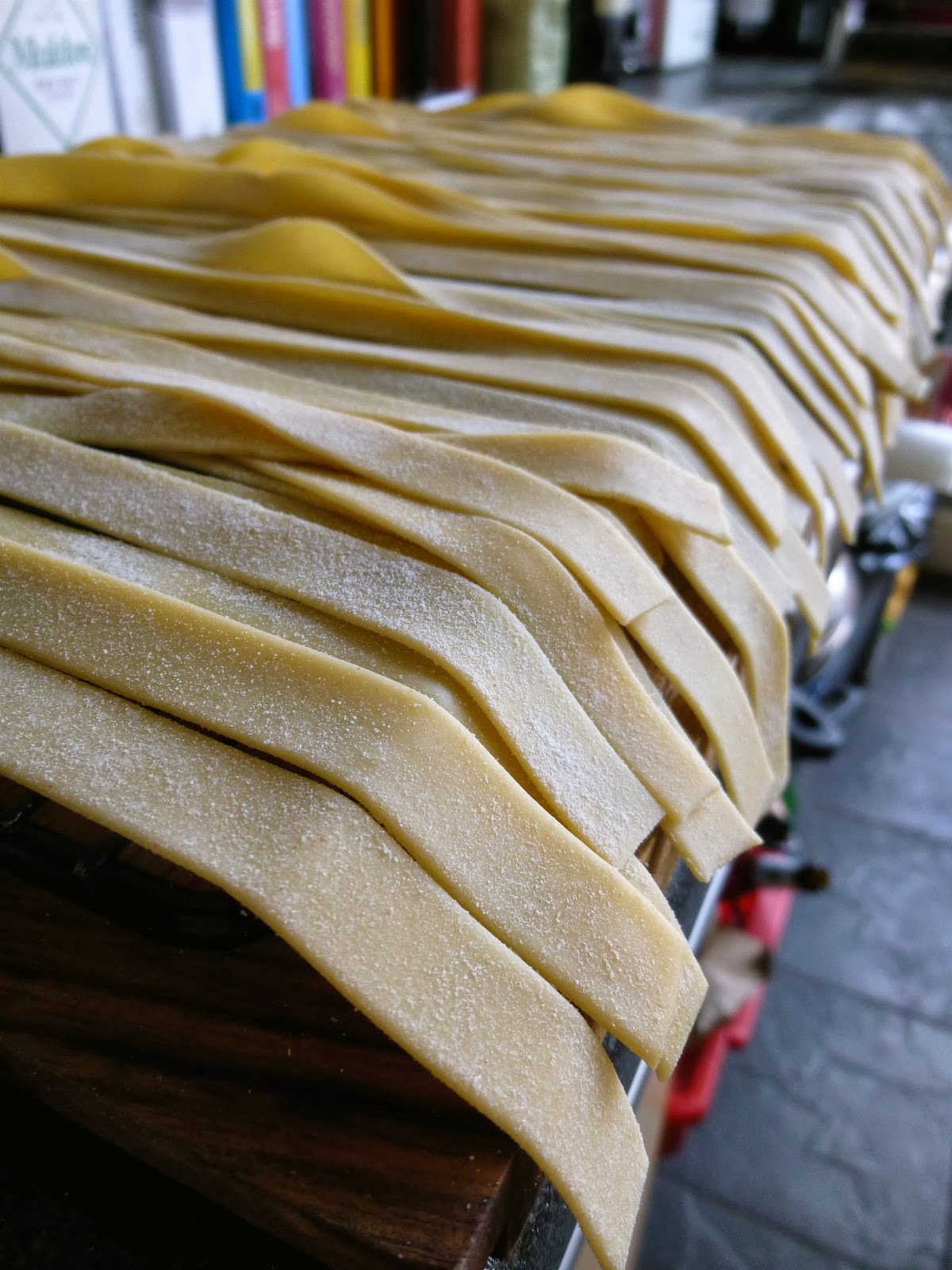
When the dough has rested, remove it from the fridge and cut it into four pieces. Dust with a little flour, then pass one piece through the widest setting of a pasta machine. Repeat 7-8 times, or until the dough has a really elastic texture. Rub with a little more flour if it starts to turn sticky at this point. Now roll the pasta down through each setting on the machine you get to the second thinnest; number 5 on an Imperia machine. Sprinkle the outside of the sheet with flour, cover with a clean tea towel and repeat with the other pieces of pasta dough. Cut the sheets to the length that you want the pappardelle to be, then pass through the pasta cutter. Dust a cooling rack with flour and lay the individual strands down to dry. Keep the pasta separate and in one layer to avoid sticking. 


To prepare the sage leaves, pour the oil in a small frying pan and put on a medium-high heat. When hot, add the sage in batches and cook for 20-30 seconds, or until crispy, then remove to a plate lined with kitchen roll. Set aside until needed later.


After 5 hours, carefully remove the meat and a little of the liquid to a bowl and allow to cool. Once cold, finely shred the meat and set aside. Strain the remaining stock from the saucepan through a sieve into a large bowl and discard the cooked vegetables. Set a large, high-sided frying pan or skillet onto a medium-high heat and add a little oil. Add the bacon and cook for a couple of minutes until starting to colour, then add the shallot and fry for another 2 minutes. Now pour in the strained stock. Turn the heat up and allow to reduce by at least half, until just enough is left to hold the shredded meat. Turn down to a simmer and add the meat, combining well so that the sauce and meat come together as one. Taste and season if necessary, then turn the heat right down until needed. 


Fill a large saucepan with well-salted water and bring to the boil.


While the water is boiling, raise the heat of the ragu sauce pan to a simmer.


When the water boils add the pasta. Cook for 1-2 minutes, until just al dente.


While the pasta is cooking, add the cubed butter and grated pecorino to ragu sauce and stir well to combine. Taste and add salt and pepper if needed. As soon as the pasta is cooked, use tongs to transfer the pappardelle to the pan with the ragu and toss to combine well, so that every strand is coated. Remove from the heat.


Heat up a medium sized frying pan to a moderate temperature and add the butter for the mushrooms. Fry the garlic for 30 seconds then add the prepared girolles, cooking for another couple of minutes until crisp on the outside and soft in the middle.


To plate, spoon a generous amount of the pasta into bowl and top with some of the girolles and sage leaves. Grate over some more pecorino, grind some black pepper and drizzle a little extra virgin olive oil.

Tuesday, 15 January 2013

Rump of lamb with confit carrots, purple carrot and anchovy puree, carrot crisps, flageolet beans and red wine sauce


I can’t believe that this is the first time that I have cooked lamb for this blog! I absolutely love it, and there is nothing better than a roasted leg of lamb filling the house full of amazing smells on a cold Sunday afternoon. To be honest though I don’t really eat that much red meat on a week to week basis; as I’ve said before on this blog, good meat is pricey and always a treat, and I’d rather eat better quality meat less often and vegetable-based dishes the rest of the time. It has to be said though, I work opposite an amazing fishmongers, so when payday comes around I have often earmarked a fish or two to buy before even thinking about anything else. 

At this time of year though, lamb in particular comes into it’s own and I couldn’t resist ordering some from my local butchers. Purists will say that spring lamb is best, but for me lamb that is a little older holds much more flavour yet can still be soft and tender. Living in Stoke Newington, I am really lucky to have a great butcher just around the corner in the shape of Meat N16. Although still relatively new, they have already won awards and are always really friendly when I have shopped there. More importantly, the meat is great quality. There are a number of different lamb cuts that suit a variety of cooking methods, and for this recipe I decided to use the rump. This cut is off the bone and is cooked in a similar way to a steak; crusty on the outside and pink and tender in the middle. 


The carrots stand side by side with the lamb as stars of this dish. I have recently seen purple and yellow carrots in my local greengrocers and have been eager to do something with them. Often carrots are just boiled to death and plonked on the side of a meal to add a bit of colour, but I wanted to try and make them more interesting and stand up in their own right. Making them different textures and flavours might seem like unnecessary work, but each part adds to the finished dish. 

The rest of the flavours and ingredients in this recipe; the beans, anchovies, mint and red wine are all classic accompaniments to lamb. There is quite a lot of acidity in this dish from the use of lemons, but these help cut through the fattiness of the lamb and the sweetness of the carrots. As with anything it’s all about everything working together and the flavours balancing. 


Although lamb stock isn’t that widely available, it’s dead easy to make and really worth it. Even using the leftover bones and scraps from a sunday roast with some root vegetables and water will produce something delicious. Failing that, good chicken stock can be used as a substitute. 

Don’t be put off with the amount of butter needed for the confit carrots. This is all used to make the clarified butter, and hardly any of this finds it’s way into the finished carrots. It’s mostly just to make sure the carrots are fully covered whilst cooking. Do not discard the clarified butter once finished, it can be used to make lovely roast potatoes!

Serves 2

Ingredients:

1 lamb rump, approx 400g, sliced into 2 pieces

For the purple carrot and anchovy puree:

2 purple carrots, peeled and chopped into 1” pieces
3 anchovy fillets
1 lemon, juice only
1 tsp butter
Salt and pepper

For the flageolet bean puree:

400g (or 1 tin) cooked flageolet beans
1 large handful mint, leaves picked
1 handful watercress, washed
1 - 1 1/2 lemons, juice only
1 tbsp olive oil
1 garlic clove, finely chopped
Salt and pepper

For the confit carrots:

6 carrots, 2 of each colour if using, trimmed and peeled to an equal size
750g butter
2 garlic cloves, crushed
3 sprigs thyme
Salt and pepper

For the carrot crisps:

3 carrots, 1 of each colour if using
Vegetable oil for deep frying, about 1ltr
Salt

For the red wine sauce:

2 glasses red wine
500ml lamb stock
1 tbsp sugar
1 tbsp butter
Salt and pepper

The first thing to make are the confit carrots. Heat the oven to 80ºC. Put the butter into a saucepan and cook on a medium heat, without colouring, until the butter has separated. Strain the butter through kitchen paper (you may have to be patient with this) and discard the solids caught in the paper. Put the peeled and trimmed carrots into a small, deep oven dish with the thyme, garlic and seasoning and cover with the clarified butter. Put into the oven and bake for around 2 hours, or until just tender. This can be done in advance and reheated when serving.


To make the flageolet bean puree, bring a small saucepan of water to the boil. When hot, drop in the mint and watercress and blanch for ten seconds before removing to a bowl of very cold water. Squeeze out the excess liquid when cool and transfer to a food processor with the flageolet beans, garlic, oil, lemon juice and salt and pepper. Blitz until very smooth, then taste and add more seasoning or lemon as needed. Pass through a fine sieve and set aside.


For the purple carrot and anchovy puree, bring a small saucepan of salted water to the boil. Add the chopped purple carrots and cook until tender, about 6-8 minutes. Drain well and transfer to a food processor with the anchovies, lemon juice, butter and seasoning, and mix until very smooth. Taste and adjust the seasoning if needed. Pass through a fine sieve and set aside. 

Now make the carrot crisps. Using a speed peeler make long shavings across the middle cross section of the carrots. Heat up the frying oil in a medium - large saucepan until it reaches 140ºC, then fry the carrot shavings in small batches for a minute or two until crisp. Transfer to kitchen paper and drain well, then sprinkle with a little salt. 


To make the red wine sauce, put a dry medium saucepan on a moderate - high heat. When hot, add the red wine and allow to boil and reduce by half. Pour in the lamb stock and add the sugar and a little seasoning and allow to reduce right down until the sauce starts thicken and becomes shiny. Be careful not to reduce it too much at this point or the sauce will become bitter. Taste and season. 

Pre-heat the oven to 190ºC (fan).

For the lamb, heat up a heavy non-stick saucepan to a high heat. Season the lamb well on all sides and rub with a little oil. Fry the lamb for a minute or two fat side down until golden brown, then seal the rest of the meat for 20-30 seconds on each side. Transfer to an oven tray and cook in the oven for 9-10 minutes for medium-rare lamb. Use your fingers as you would with steak to test how the meat is cooked inside. Move the cooked lamb to a chopping board, cover with foil and allow to rest for about 10 minutes. 


While the lamb is resting, heat up the confit carrots, the sauce and the the purees (very gently). Add the butter to the sauce and stir well until incorporated. Check the taste and seasoning again.

To plate up, spoon some of the flageolet bean puree onto the middle of the plate and arrange 2 thick slices of the lamb on top. Add a bit of the purple carrot puree on the side, arrange the confit carrots around and spoon over some of the sauce.